


Walking Tractor
Your Professional Walking Tractor Supplier
Linyi Junsai Machine Trade Co,.Ltd. is located in the famous machinery industry and international trade city----- Linyi City, Shandong, China.Our company is specialized in agricultural machines(walking tractor, four wheel tractor and multifunctional farm implements), construction machine (Wheel Loader, Skid Steer Loader ),electric vehicles (electric tricycle, electric bicycle) , with many years of international experiences.




Why Choose Us
Fast Delivery
The delivery speed is fast, and the delivery will be sorted out for you as soon as the order is placed.
Good Service
Our corporation follows a policy of "innovation, standardization, integrity, service".
Quality Assurance
With our strong comprehensive strength, we will continue to provide high-tech high-quality and highPerformance of agricultural machinery and compact construction machine.
Sales Market
Most of our products are exported to international market: Asia, Australia, New Zealand, Russia, Ukraine, Moldova, Africa, the USA, South America, Canada etc.
Main Features of Walking Tractor


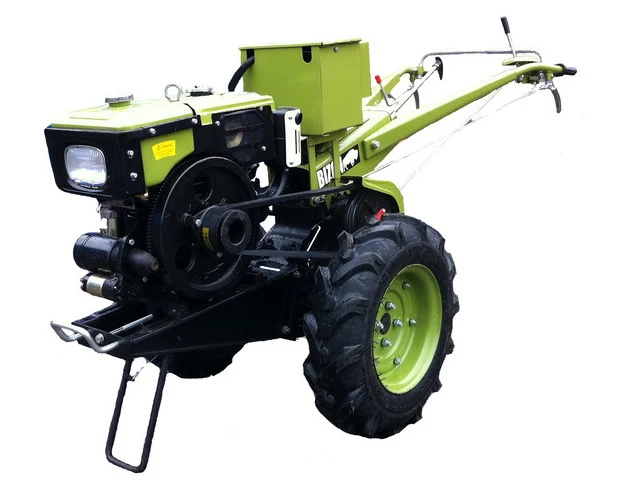
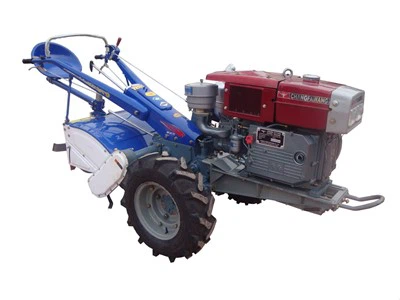
A variety of attachments
walking tractors work with a broad range of attachments. A hitch enables you to change the implement attached to the two-wheel tractor. However, these hitches are not uniform, particularly for PTO-powered attachments.
Multi speed gearbox
Most modern two-wheel tractors have a multi-speed gearbox. For example, BCS 750 model has three gear transmissions (3 forward, 3 reverse) while the 722 has two (2 forward and 2 reverse).
An option to add weight
Walk-behind tractors stand out for causing minimal soil compaction which leads to higher water infiltration rate and boosted plant root growth. However, their lightweight may turn into a drawback where machine balance, deep cultivation, and traction are required.
Track width and tire adjustment options
Some tractors especially those meant for plowing between crop rows have adjustable track widths. This is because the spacing between crop rows may fluctuate. Basically, track width adjustment is achieved by using an axle add-on or by disconnecting the wheel hubs and relocating them.
Lockable Differential
Most modern-day walk-behind tractors have differential lock features. A differential refers to a mechanical component of a car, truck, or other vehicle that splits the power from the engine and allows the wheels to spin at different speeds.
Power Take Off (PTO)
The conventional way of attaching implements to the tractor is by the use of bolts. But the process of screwing the bolts is tedious and time-consuming.
Reversible handlebars
A unique and useful feature of modernized walk-behind tractors is a reversible pair of handlebars that allow the user to walk on either side of the implement when working on the field.
Offset Handlebar Positioning
With the current walking tractors, you can offset the handlebars to the left or right. This enables you to drive the tractor more safely especially near fences and under overgrown vegetation.
Handlebar Height Adjustment
Present-day two-wheel tractors have a feature to regulate handlebar height. This not only eases day-to-day field applications but also allows you to lift, slide, or shift the machine when required.
Specification
|
Model |
Unit |
SH151 /SH181 |
|
|
Structure weight |
Without rotavator |
kg |
255 |
|
With rotavator |
315 |
||
|
Working weight (with rotavator) |
kg |
355 |
|
|
Overall dimensions (LxWxH) |
mm |
2380x1100 x 1250 |
|
|
Number of blades |
PCS |
20 |
|
|
Rototilling width |
mm |
1000 |
|
|
Type of tractor |
|
Single axle, dual-purpose for both traction & drive |
|
|
Travelling speed |
Forword |
Km/h |
2.01, 3.32, 5.31, 6.76, 11.18, 17.86 |
|
Reverse |
3.28, 11.03 |
||
|
Type size |
|
6.00-16 |
|
|
Wheel track |
mm |
800~1000(normally use 1000) |
|
|
Min. ground clearance |
mm |
224 |
|
|
Min. turning radius |
m |
0.9(with no rotavator) |
|
|
Model of engine |
|
1105N/1110N/1115N |
|
|
Type of engine |
|
Horizontal 4-stroke |
|
|
Bore x stroke |
mm |
100×105 |
|
|
Total displacement |
L |
0.602 |
|
|
Compression ratio |
|
22:01 |
|
|
Turing speed of crankshaft |
rpm |
2600 |
|
|
1-hour rated output |
KW/hphp |
13.5 |
|
|
12-hour rated output |
KW/hp |
12.8 |
|
|
Specific fuel consumption |
g/kw.h |
≤387 |
|
|
Specific lube oil consumption |
g/kw.h |
≤4.08 |
|
|
Cooling mode |
|
Condenser (Radiator) |
|
|
Main farm implements (optional) |
Anti-skid steel wheel Single-furrow plough |
||
Types of Walking Tractor
Horsepower-based classification
Horsepower is a measurement unit used to quantify the power output of engines and machines. Based on horsepower, walking tractors can be divided into big horsepower tractors and small horsepower tractors. Big horsepower tractors have more power and can handle more demanding tasks. Meanwhile, small horsepower tractors are more efficient and suitable for small-scale farming.
Engine-based classification
The engine is the heart of a walking tractor that provides the necessary power for operation. There are usually two main fuel types: diesel and gasoline. Diesel fuel typically has higher energy density and produces more torque. Diesel walking tractors also have a longer lifespan and lower operating costs. Gasoline tractors are more suitable for light-duty and small-scale use.
Chassis-based classification
The chassis of the walking tractor is the base for supporting all the other components. It provides a mobile platform for farming operations. Moreover, the two-wheel and four-wheel walking tractors are available. Typically, two-wheeled walking tractors are lighter and more maneuverable. On the contrary, four-wheeled tractors offer better stability and suitable for larger size and tougher farming tasks.
Functional implements
The functional implements of a walking tractor refer to the attachments and accessories that can be used together with the tractor.
Schedule routine maintenance based on machine hours:
Keep track of how many hours the tractor has been operated and schedule maintenance tasks accordingly. Manufacturer manuals often specify service intervals for oil changes, belt replacement, and other checks.
Train all users on safe operation and troubleshooting:
Whether it’s the farm owner, employees, or hired operators, everyone should receive proper training. This training should cover start-up and shutdown procedures, correct attachment use, emergency protocols, and basic troubleshooting.
Keep a detailed logbook of maintenance and repair history:
Document every maintenance action, repair, or replacement performed on the tractor. This record helps monitor the machine’s condition, anticipate future needs, and maintain resale value.
Use manufacturer-recommended parts and fluids:
Using high-quality replacement parts and the correct type of lubricants and fuels extends the tractor’s life and maintains warranty coverage.
Perform safety checks before every use:
Operators should inspect the tractor daily for loose bolts, leaks, tire condition, and proper functioning of brakes and controls.
Industry scenarios of Walking Tractor
Agriculture:
Walking tractors are common in smaller-scale farming, especially where tractors are too big. Farmers use them to plow, plant, cultivate, spray, and haul crops. In orchards and vineyards, they help with row crop management and trellis work. For livestock, walking tractors handle feed transport and manure management, too. Farmers also use them to haul products to market.
Horticulture:
In garden farming, walking tractors make it easier to grow flowers, veggies, and landscaping plants. They are good for plowing, soil prep, planting, weed control, irrigation set-up, and harvesting in greenhouses and open fields.
Forestry:
Walking tractors help in sustainable woodland management. They carry out site prep, tree planting, and thinning, plus they haul low-tech log extraction vehicles. Walking tractors minimize soil compaction compared to wheeled tractors, which makes them a better choice for delicate woodland areas.
Land Reclamation:
When restoring damaged land, walking tractors are very useful. They turn the soil, prep the ground, and plant seeds on places like ash heaps, landfills, and mine spoils. Their simple movement and flexibility let them work where bigger machines can't.
FAQ