


Mini Skid Steer Loader
Your Professional Mini Skid Steer Loader Supplier
Linyi Junsai Machine Trade Co,.Ltd. is located in the famous machinery industry and international trade city----- Linyi City, Shandong, China.Our company is specialized in agricultural machines(walking tractor, four wheel tractor and multifunctional farm implements), construction machine (Wheel Loader, Skid Steer Loader ),electric vehicles (electric tricycle, electric bicycle) , with many years of international experiences.


Why Choose Us
Fast Delivery
The delivery speed is fast, and the delivery will be sorted out for you as soon as the order is placed.
Good Service
Our corporation follows a policy of "innovation, standardization, integrity, service".
Quality Assurance
With our strong comprehensive strength, we will continue to provide high-tech high-quality and highPerformance of agricultural machinery and compact construction machine.
Sales Market
Most of our products are exported to international market: Asia, Australia, New Zealand, Russia, Ukraine, Moldova, Africa, the USA, South America, Canada etc.
Advantages of Mini Skid Steer Loader
Compact Size:
They’re designed to fit into areas that full-sized skid steers can’t access, like small backyards or narrow alleys.
Versatility:
With a range of attachments available, mini skid steers can handle multiple tasks, from digging and trenching to moving materials.

Ease of Transport:
Because of their lightweight and compact build, mini skid steers can be transported easily between job sites, even on a standard trailer.
Reduced Ground Impact:
Their lighter weight means they exert less pressure on the ground, reducing the risk of damaging sensitive surfaces like lawns or soft soil.
Types of Mini Skid Steer Loader
Wheeled Skid Steers
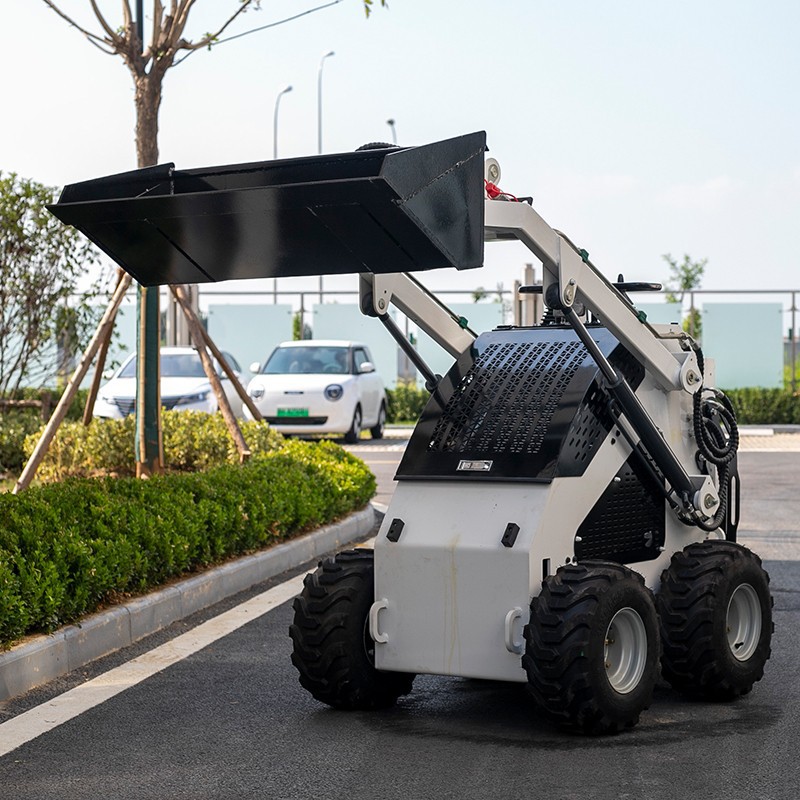
Wheeled skid steers are the most common, and are equipped with four wheels. They offer excellent maneuverability on flat and paved surfaces, making them suitable for indoor construction projects, landscaping, and material handling tasks.
Tracked Skid Steers
Tracked skid steers, also known as compact track loaders or CTLs, operate on rubber tracks instead of wheels. These machines provide enhanced traction and stability on rough, uneven, or soft terrains.
Stand-On/Walk-Behind Skid Steers
Stand-on skid steers, also known as stand-on loaders, offer a different operating platform compared to traditional skid steers. Instead of sitting in a cab, operators stand on a platform attached to the back of the machine.
All-Wheel Skid Steers
Also called skid steers with all-wheel steering or skid steer loaders with crab steer, feature an additional steering mechanism that allows the rear wheels to steer independently from the front wheels. This configuration enhances maneuverability and stability in challenging terrains or tight spaces. All-wheel steer skid steers are commonly used in construction, agriculture, and snow removal applications. They provide exceptional versatility and precise control, making them ideal for tasks that require enhanced maneuverability and minimal surface damage.
Specification
|
Item |
Value |
|
Applicable Industries |
Farms, Home Use, Construction works , Energy & Mining |
|
Place of Origin |
China |
|
Warranty |
1 Year |
|
Machine Weight |
380kg |
|
UNIQUE SELLING POINT |
High operating efficiency |
|
Power |
17.2 kw |
|
Drive type |
Crawler Drive |
Components of Mini Skid Steer Loader
The Power Source: Engine and Fuel System
Every skid steer relies on the power of the engine and fuel system to perform. SSLs have either diesel or gasoline engines, each carrying its own set of advantages.
The Heart of Movement: Hydraulic System
Moving from the engine and fuel system, another vital SSL component is the hydraulic system. This intricate network of hydraulics serves both the skid steer's movement and the operation of their various attachments.
Driving Control: Wheels and Tires
The level of control comes down to the design and function of its wheels and tires. Whether equipped with traditional wheels or tracks, these components are necessary for the skid steer's maneuverability and performance on diverse terrains.
The Operational Core: Lift Arms and Attachments
At the operational core of a skid steer lies its versatility, with its combination of lift arms and an array of attachments. These components are the reason why these machines are so multifunctional on the job site. It's important to note that every skid steer model has different lifting capacities. You can see the rated operating capacity of each model in our skid steer spec guide.
Operator's Station: Cab and Controls
The operator's station stands as a control system with essential safety features. This enclosed space shelters the operator from the construction environment while housing the controls for the skid steer's movements and actions.
Maintaining Stability: Counterweights
Counterweights play a huge role in a skid steer's overall stability. As these machines are designed for versatility and dynamic movements, the distribution of weight becomes very important. When lifting heavy loads or engaging in tasks that shift the machine's center of gravity, counterweights step in to counterbalance these forces, preventing potential tip-overs or loss of control.
Cooling and Exhaust Systems
Cooling systems protect the skid steer's engine from the perils of overheating. As these machines routinely undertake demanding tasks, the engine generates substantial heat. The cooling system, often comprised of a radiator and fan, efficiently dissipates this heat, preventing the engine from reaching critical temperatures.
Electrical Components and Systems
The main electrical component is the battery that kickstarts the skid steer's engine. This rechargeable energy source provides the initial jolt needed to start the engine, just like a normal car. Regular checks on battery health include ensuring secure connections and addressing any signs of corrosion or wear. Neglecting the battery will prevent the skid steer's ability to start but also the operation of essential electrical components.
Application of Mini Skid Steer Loader
Grading and backfilling:
You can also fill in holes, level out the ground and aerate it with a skid steer. You can use a bucket for these tasks, but a rake attachment or a grading bar works even better when you’re leveling.
Loading:
Skid steers can help you carry equipment and materials around the job site using a bucket attachment. If you need to lift materials, you may want to consider a vertical lift rather than a radial lift skid steer since these models can lift heavier loads and achieve a higher reach.
Mowing:
You may be surprised to know you can also use a skid steer to mow. With a rotary brush cutter, you can cut down tall grasses and other growth to efficiently clear an area. You may even be able to cut down some smaller trees.
Landscaping:
Some of the tasks we’ve already looked at are useful for landscaping. Other examples of landscaping tasks you can accomplish with a skid steer are grinding stumps, chipping wood and tilling. You can even use a tiller attachment to help mix in compost or fertilizer into the soil.
Agricultural work:
Skid steers can also be highly useful for farm work. You can use them for tilling and other tasks we’ve already mentioned. Plus, you can use a bucket attachment to clean out barns and stables.
FAQ